
Abstract
Stadiy combines document reading, contextual AI dialogue, practice questions, notes, and review in one study environment. This technical paper examines the learning-science rationale for that design through a selected review of AI tutoring, retrieval practice, and spaced retrieval. Published studies report benefits for particular learning and retention outcomes, but those effects depend on the task, instructional design, comparison condition, and assessment delay. We distinguish these external findings from Stadiy’s product capabilities and outline an evaluation approach based on delayed, unaided performance. No Stadiy-specific efficacy study or participant outcomes are reported here.
Scope and review method
This is a narrative evidence review and product-design analysis, not a systematic review, preregistered experiment, or new meta-analysis. Four primary publications were selected to cover structured AI tutoring, the risks of unrestricted assistance, retrieval practice, and retrieval spacing. Publisher records and openly available primary texts were checked on 29 October 2026.
Charts transcribe reported summary statistics rather than reconstruct participant-level data. Medians, mean recall percentages, and standardized effects are displayed separately. We do not pool them or estimate missing uncertainty. The reviewed outcomes concern learning and memory for studied material; they do not establish improvements in general intelligence, clinical cognition, or all-purpose reasoning.
Stadiy as a study system
A book or PDF supplies the reference material for a study session. Reading activity, page-linked notes, and book-specific conversations preserve the relationship between source material and the work around it. General conversations have a separate space. The AI can explain a passage, connect it with broader knowledge, or use diagrams and mathematical notation to represent a concept.
Practice changes the learner’s role from reading an explanation to producing an answer. Stadiy supports questions, quizzes, and exams based on material already read, followed by assessment and review. Page images can contribute to questions as well as text. Earlier answers inform subsequent review opportunities. These are product capabilities described in the product brief, not findings from an independent evaluation.
Stored documents, local notes, and reading records can remain available without a connection. AI responses, connected dictation, and account sync use online services. Dictation is an input method; the studies reviewed here do not test a cognitive benefit from speech input.
A study session as a feedback loop
- Source materialBook, PDF and notes
- ExplanationQuestion and context
- RetrievalLearner attempts an answer
- Feedback and reviewAssess, then revisit
Evidence from AI tutoring
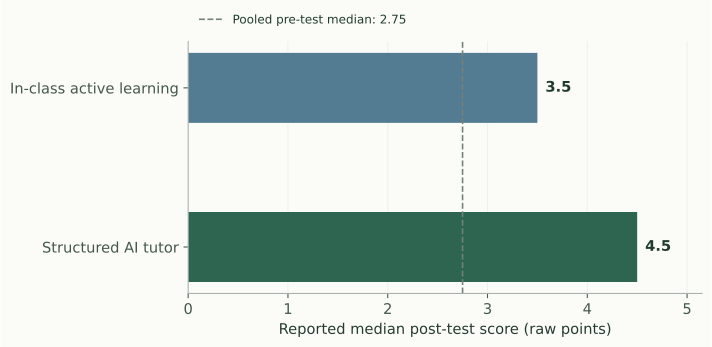
Kestin and colleagues studied a purpose-built AI tutor in undergraduate physics using a randomized crossover design. The reported median post-test scores were 4.5 with AI tutoring and 3.5 with in-class active learning; the pooled pre-test median was 2.75 [1]. This result concerns two lessons with carefully designed instructional support. It does not establish that a generic chatbot, every subject, or Stadiy produces the same benefit.
Structured AI tutoring and post-test performance

| Condition | Median score |
|---|---|
| In-class active learning | 3.5 |
| Structured AI tutor | 4.5 |
Retrieval and delayed retention
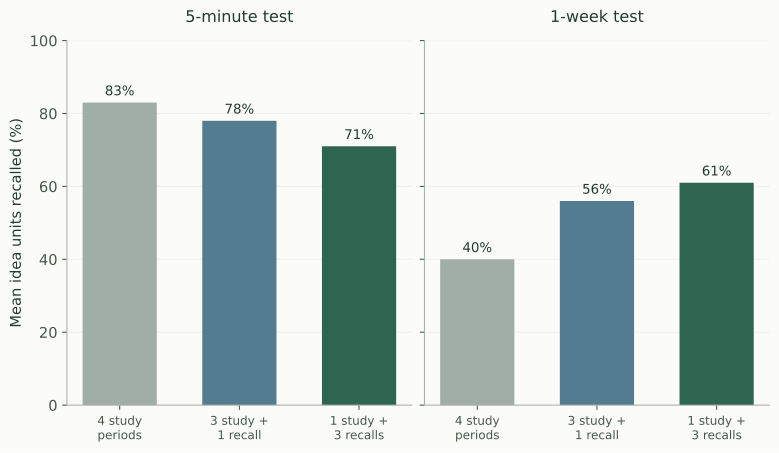
Roediger and Karpicke’s second experiment compared study and free-recall periods in 180 undergraduates. Four study periods produced higher immediate recall, but one study period followed by three recalls produced better retention after a week: 61% of idea units versus 40% after repeated study [2]. The reversal shows why immediate fluency and delayed retention should be assessed separately.
Immediate recall and delayed retention

| Learning periods | 5 minutes | 1 week |
|---|---|---|
| 4 study | 83% | 40% |
| 3 study + 1 recall | 78% | 56% |
| 1 study + 3 recalls | 71% | 61% |
Spacing retrieval sessions
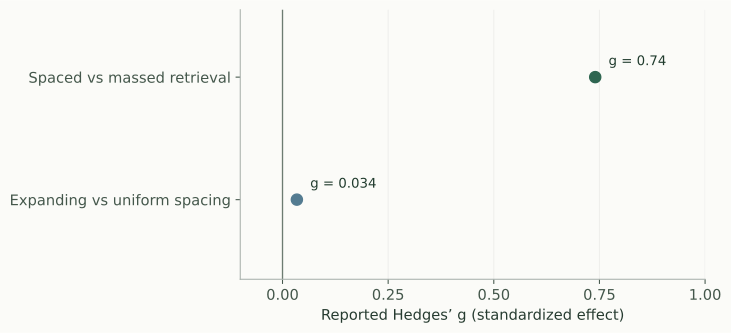
Latimier and colleagues synthesized 29 studies. Their published abstract reports Hedges’ g = 0.74 for spaced versus massed retrieval and g = 0.034 for expanding versus uniform schedules, with no significant advantage for the latter comparison [3]. The first value is a standardized effect, not a 74% increase in recall. This evidence supports distributing retrieval opportunities; it does not identify one universally optimal interval schedule.
Spacing retrieval versus changing the spacing schedule

| Comparison | Hedges’ g |
|---|---|
| Spaced vs massed retrieval | 0.74 |
| Expanding vs uniform spacing | 0.034 |
Guardrails and independent performance
Bastani and colleagues tested two AI-assistance designs in high-school mathematics. Relative to control, assisted practice grades improved by 48% for GPT Base and 127% for GPT Tutor. On a subsequent unassisted exam, GPT Base performance was 17% lower; the guarded tutor did not show a statistically distinguishable improvement over control [4]. These are relative changes, not percentage-point differences.
The design implication is to distinguish help with solving today’s task from learning to solve the next one independently. Asking for an attempt, using targeted hints, and checking unaided performance are therefore important evaluation priorities. Whether a particular Stadiy interaction achieves those aims requires direct testing.
Design implications for Stadiy
The evidence motivates a sequence of source engagement, explanation, an attempted answer, feedback, and later retrieval. It does not validate each product feature independently. Saved chats can preserve context; a reading timer can describe activity; neither measure alone establishes learning.
A technical evaluation should examine source fidelity, factual and mathematical correctness, answer-assessment agreement, and the quality of feedback. Where a question uses a page image, the evaluation should also check whether the relevant visual information was interpreted correctly. These checks complement, rather than replace, tests of what the learner remembers without assistance.
| Product element | Learning mechanism | What requires evaluation |
|---|---|---|
| Contextual dialogue | Explanation and scaffolding | Source fidelity and feedback accuracy |
| Questions and quizzes | Active retrieval | Unaided retention and answer quality |
| Later review | Distributed retrieval | Retention across assessment delays |
| Notes and reading records | Continuity of study | Usefulness and study behaviour |
Evaluation protocol and limitations
A future Stadiy evaluation could randomize learners to matched reading-only, reading-plus-retrieval, and Stadiy-assisted conditions. Materials, study time, prior knowledge, and assessment difficulty should be balanced or explicitly modelled. A preregistered primary outcome could be unaided retention after seven days, with a later follow-up and novel transfer problems as secondary outcomes.
Report effect sizes with confidence intervals, missing data and attrition, time on task, and scoring procedures. Where possible, use assessors blinded to condition. Separate AI-present practice from AI-absent testing to detect dependence on assistance. Such a study is proposed here; it has not been conducted as part of this website.
External findings do not transfer automatically across learner ages, disciplines, languages, or model versions. The AI trial and classroom study used specific instructional designs and settings. The retrieval experiment used prose recall, and the spacing synthesis combines heterogeneous tasks. None measures Stadiy’s impact, establishes a broad cognitive improvement, or shows that more time logged necessarily means more learned.
Conclusion
AI-assisted explanation, active retrieval, and spaced review provide a plausible research-informed basis for Stadiy’s study workflow. The strongest product claim supported here is about its design rationale. Claims about improved learning with Stadiy should depend on measured, delayed, unaided outcomes rather than the presence of AI or the appearance of a successful practice session.
References
- [1]Kestin, G., Miller, K., Klales, A., Milbourne, T., & Ponti, G. (2025). AI tutoring outperforms in-class active learning: an RCT introducing a novel research-based design in an authentic educational setting. Scientific Reports, 15, 17458. doi:10.1038/s41598-025-97652-6
- [2]Roediger, H. L., III, & Karpicke, J. D. (2006). Test-enhanced learning: Taking memory tests improves long-term retention. Psychological Science, 17(3), 249–255. doi:10.1111/j.1467-9280.2006.01693.x
- [3]Latimier, A., Peyre, H., & Ramus, F. (2021). A meta-analytic review of the benefit of spacing out retrieval practice episodes on retention. Educational Psychology Review, 33, 959–987. doi:10.1007/s10648-020-09572-8
- [4]Bastani, H., et al. (2025). Generative AI without guardrails can harm learning: Evidence from high school mathematics. Proceedings of the National Academy of Sciences, 122(26), e2422633122. doi:10.1073/pnas.2422633122
Data and figures
Figures were newly plotted from the cited summary statistics. They are not reproductions of the publishers’ artwork or a reanalysis of participant-level records. Error bars have not been invented where numerical uncertainty was not extracted. Figure 1 is a product concept diagram; Figures 2–4 concern external research.
Download the values and provenance (JSON)
This paper was prepared for Stadiy’s product website. The product description is supplied by the owner; the study findings belong to the cited researchers. This document is not peer reviewed and does not report an independent validation of Stadiy.